Research
Multi-scale, multi-physics flows at extreme scale
Our group works at the intersection of numerical methods, high performance computing and machine learning. We build the algorithms, run the simulations and analyse the data, with turbulent flows as the driving application.
Asynchronous and scalable PDE solvers

At extreme scales, data movement and synchronisation between processing elements limit how far PDE solvers scale. We relax synchronisation at the level of the numerical method. Asynchrony-tolerant schemes keep their order of accuracy when neighbouring processors exchange data at different times. We have built these schemes into finite-difference and discontinuous Galerkin solvers and tested them on reacting, compressible and transitional flows.
Current topics
- Asynchrony-tolerant finite-difference schemes
- Asynchronous discontinuous Galerkin methods
- Low-storage Runge–Kutta time integration for asynchronous solvers
- Performance-portable solvers for CPUs and GPUs with Kokkos
Selected papers
- Accuracy and scalability of asynchronous flow solver for transitional flowsComputers & Fluids, 2026
- An asynchronous discontinuous Galerkin method for massively parallel PDE solversComput. Methods Appl. Mech. Eng., 2024
- Evaluation of finite difference based asynchronous PDE solver for reacting flowsJ. Comput. Phys., 2023
- High-order asynchrony-tolerant finite difference schemes for PDEsJ. Comput. Phys., 2017
Sponsored projects
- Scalable asynchronous finite-volume solver for cumulus entrainment. MoE STARS, 2023–2026
- Hardware-aware algorithms in scientific computing. DST–DAAD Indo-German Partnership, 2020–2024
- Scalable simulation workflows for PDE solvers. National Supercomputing Mission, 2021–2023
- Scalable asynchronous computing method for PDEs. SERB Start-up Research Grant, 2020–2022
Scientific machine learning & AI

Simulations of turbulent reacting flows produce data that are large, multi-scale and strongly non-linear. We design learning methods around this structure and judge them on physical quantities. Our work covers dimensionality reduction for chemical kinetics using higher-order statistical moments, super-resolution of turbulent fields, graph neural networks for complex meshes and data-driven detection of rare and extreme events.
Current topics
- Co-kurtosis based reduced models for chemical kinetics
- Self-supervised super-resolution of turbulence
- Graph neural networks on unstructured meshes
- Detection of anomalies and precursors of flashback
Selected papers
- An a posteriori analysis of cokurtosis PCA-based dimensionality reduction using a neural ODE solverCombust. Sci. Technol., 2026
- A scale-similarity based workflow for self-supervised reconstruction of small-scales in turbulencePhys. Fluids, 2024
- Data-driven identification of precursors of flashback in a lean hydrogen reheat combustorProc. Combust. Inst., 2024
- A co-kurtosis based dimensionality reduction method for combustion datasetsCombust. Flame, 2023
- Anomaly detection in scientific data using joint statistical momentsJ. Comput. Phys., 2019
Sponsored projects
- Detection of flashback in hydrogen combustion. IISc–TU Delft Joint Seed Grant, 2022–2023
Turbulent combustion and propulsion
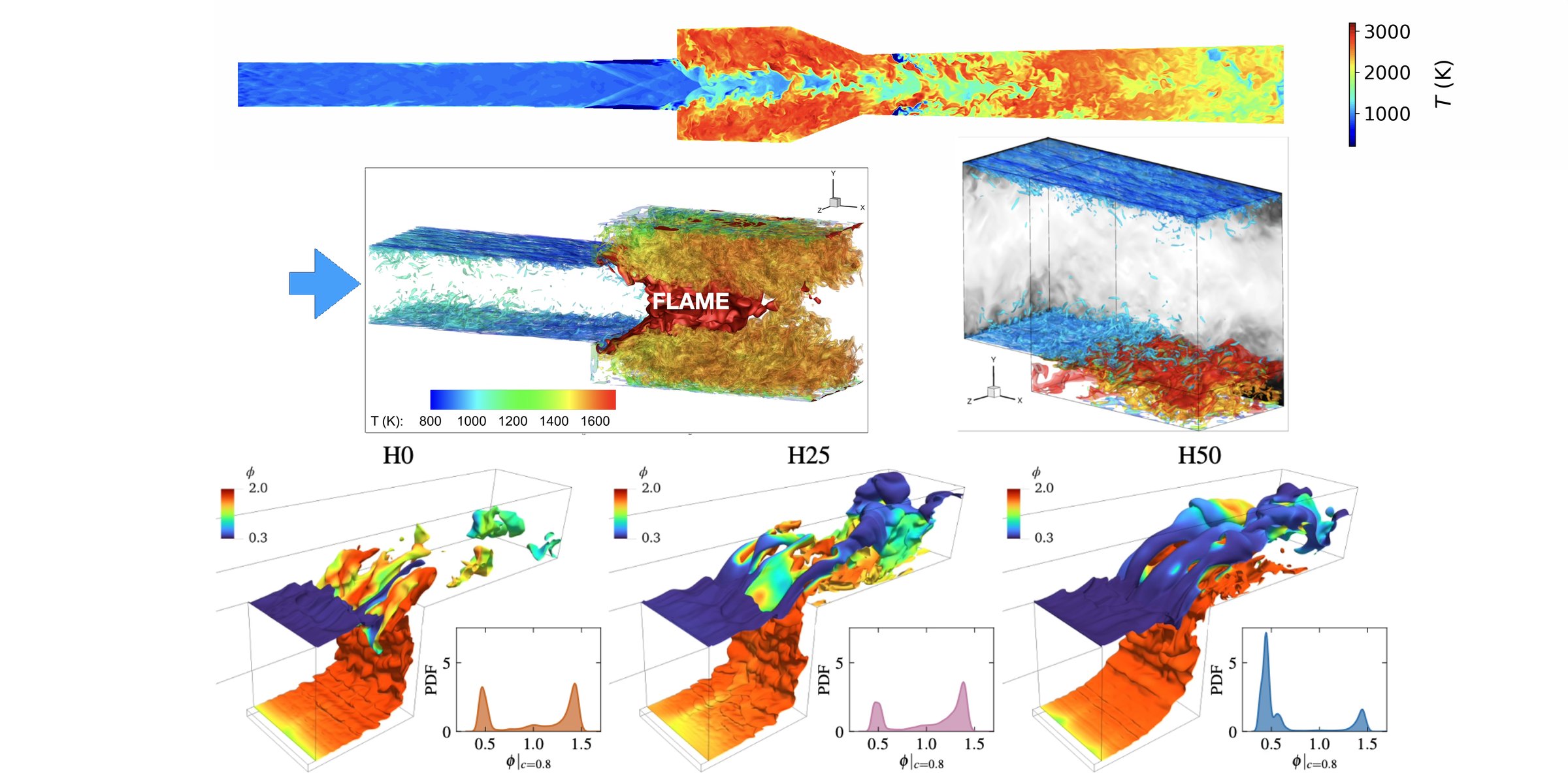
Gas turbines must burn hydrogen and other carbon-free fuels safely. We use direct numerical and large-eddy simulations to study how flames stabilise, autoignite and flash back in sequential (reheat) combustors, and how pressure and hydrogen fraction change flame structure. We also study ammonia in trapped vortex combustors, premixed flames in scramjet cavities, and reaction pathways extracted from reactive molecular dynamics.
Current topics
- Autoignition and flame stabilisation in hydrogen reheat combustors
- Flashback prediction and prevention
- Ammonia combustion in trapped vortex combustors
- Reaction detection from atomistic simulations
Selected papers
- Large-eddy simulations of an ammonia-fired trapped vortex combustorASME Turbo Expo, 2026
- ChemXDyn: Dynamics-informed species and reaction detection methodology from atomistic simulationsJ. Chem. Theory Comput., 2026
- Spontaneous ignition and flame propagation in hydrogen/methane wrinkled laminar flames at reheat conditionsCombust. Flame, 2024
- Direct numerical simulation of hydrogen combustion at auto-ignitive conditionsCombust. Flame, 2021
- Direct numerical simulation of flame stabilization assisted by autoignition in a reheat gas turbine combustorProc. Combust. Inst., 2019
Sponsored projects
- Combustion dynamics in hydrogen-fired reheat burners. SERB Core Research Grant, 2024–2027
- Large-scale computations of reacting flow in open-cell catalytic foams. Shell Technology Centre, 2021–2023