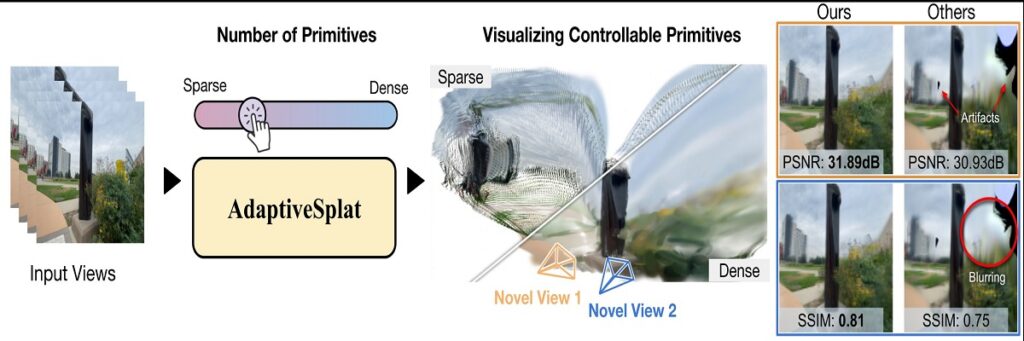
Creating a detailed 3D model of a real-world scene from photographs taken at different viewpoints is a remarkable capability, powering applications in AR/VR, autonomous driving, robotics, gaming, and digital content creation. These models, when created traditionally, contain far more information than necessary. Smooth regions don’t need the same detail as complex regions, but traditional methods allocate resources uniformly resulting in large and slow models that are costly to render and store.
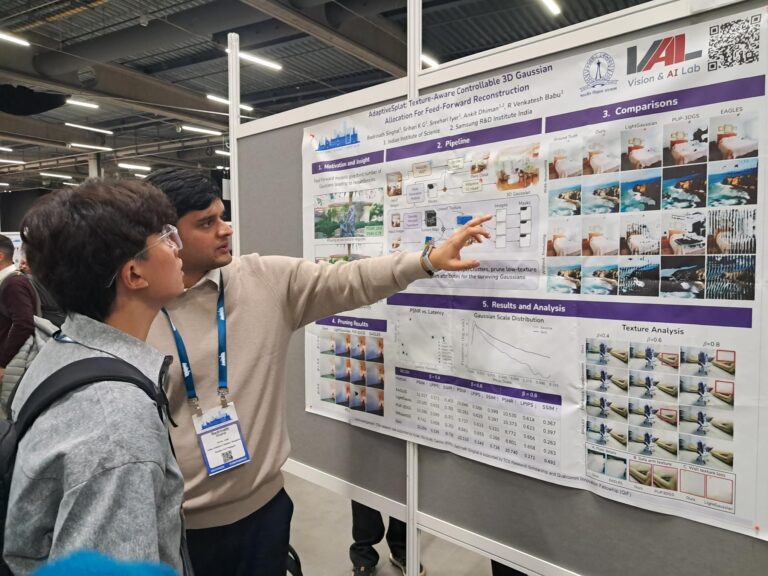
Researchers Badrinath Singhal, Srihari K. G., Sreehari Iyer, and Ankit Dhiman, working under the guidance of Prof. Venkatesh Babu at the Vision and AI Lab (VAL), CDS, IISc, identified a key observation: not all parts of a scene are equally complex—some regions require significantly more detail than others to be represented accurately.
They developed AdaptiveSplat, a 3D Gaussian representation method that carefully constructs 3D scenes based on its complexity. Their method can reduce 3D model size by up to 80% while maintaining excellent quality. It analyses images with texture estimation technique to identify which regions in each image are detailed and which are smooth. It then removes redundant information from smooth areas while preserving the remaining regions. Finally, an adaptive neural network automatically predicts the elements to fill gaps and prevent quality loss. The method was tested for various indoor, outdoor and aerial scenarios.
This work opens the door to practical 3D AI applications previously limited by computational constraints. The entire process happens within seconds, which includes processing the multi-view images and creating compact 3D scenes unlike traditional methods. This efficiency makes our approach well-suited for real-world applications, enabling smoother experiences on mobile devices, autonomous driving systems, and AR platforms. It also facilitates faster 3D asset creation for designers while reducing the demands of streaming and storage. AdaptiveSplat is available through a public codebase for experimentation and further development.
REFERENCE:
Badrinath Singhal, Srihari KG, Srihari Iyer, Ankit Dhiman, and R.Venkatesh Babu, AdaptiveSplat: Texture Aware Controllable 3D Gaussian Allocation for Feed-Forward Reconstruction, European Conference on Computer Vision (ECCV) (2026).
https://media.eventhosts.cc/Conferences/ECCV2026/pdfs/5054.pdf
Project Page: https://badrinaths.github.io/projects/adaptive-splat/